Being Prepared To Contribute

“You’ll figure it out.” The advice my dad gives has always been the same, whether addressing my grade school homework or paying bills after college. If I was looking for a shortcut, my dad wasn’t going to be the one to provide it.
When I was a kid it infuriated the hell out of me, but what I then perceived to be a lack of understanding turned out to be a keystone in my upbringing. As an adult, I realize the value in not receiving outright solutions, but being forced to figure things out.
Even today, when presented with a roadblock while building for the web, I am temped to get by with the help of the latest grid system, framework, polyfill, or plugin. In and of themselves these resources are harmless, but before I can drop them in, those damn words still echo in the back of my mind: “You’ll figure it out.”
I know that if I blindly implement these tools as drag and drop solutions I fail to understand the intricacies behind how and why they were built; repeatedly using them as shortcuts handicaps my skill set. When I solely rely on the tools of others, my work is at their mercy, leaving me less creative and resourceful, and, thus, less able to contribute to the advancement of our industry and community.
One of my favorite things about this community is how generous and collaborative it can be. I’ve loved seeing FitVids used all over the web and regularly improved upon at Github. I bet we can all think of a time where implementing a shared resource has benefitted our own work and sanity. Because these resources are so valuable, it’s important that we continue to be a part of the conversation in order to further develop solutions and ideas. It’s easy to assume there’s someone smarter or more up-to-date in any one area, but with a degree of understanding and perspective, we can all participate.
This open form of collaboration is in our web DNA. After all, its primary purpose was to promote the exchange and development of new ideas.
Tim Berners-Lee proposed a global hypertext project, to be known as the World Wide Web. Based on the earlier “Enquire” work, it was designed to allow people to work together by combining their knowledge in a web of hypertext documents.
I’m delighted to find that this spirit of collaborative ingenuity is alive and well on the web today. Take the story of Off Canvas as an example. I was at an ATX Dribbble meet up where I met Jason Weaver and chatted to him about his recent work on the responsive layout prototype, Off Canvas. Jason said he came across a post by Luke Wroblewski outlining the idea and saw this:
If anyone is interested in building a complete example of this approach using responsive Web design techniques, let me know!
From there Luke recounts:
We went back and forth on email, with me laying out ideas and Jason doing all the hard work to see if they can be done and improving them bit by bit! Once we got to something we both liked, I wrote up an article explaining things and he hosted the examples.
Luke took the time to clearly outline and diagram his ideas, and Jason responded with a solid proof of concept that has evolved into a tool we all have at our disposal. Victory!
I have also benefitted from comrades who have taken an idea of mine into development. After blogging about some concerns in regards to maintaining hierarchy as media queries are used to shift layouts, Jordan Moore rebounded with some responsive demos where he used flexbox to (re)order content as viewport sizing changes.
Similar stories can be found behind the development of things like FitVids, FitText, and Molten Leading. I love this pattern of collaboration because it involves a fairly specific process:
- Initial idea or prototype is outlined or built, then shared
- Discuss
- Someone develops or improves it, then shares it
- Discuss
- Someone else develops or improves it, then shares it.
- Infinity.
This is what the web looks like when we build it together, and I’d argue that steps 2+ are absolutely crucial. A web where everyone develops their own ideas and tools independent of one another is like a room full of people talking and no one listening.
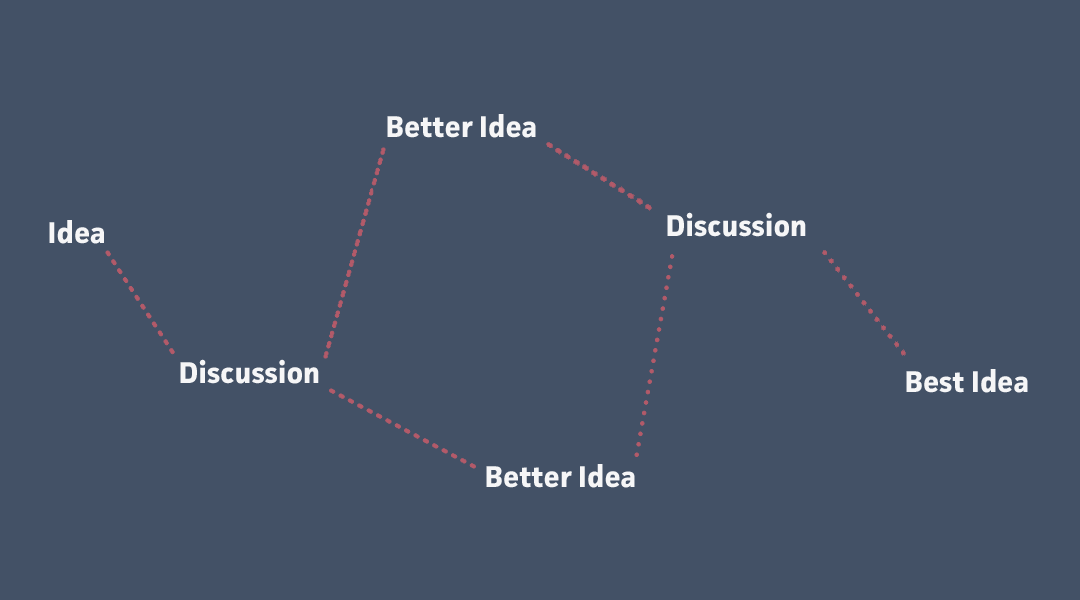
The pattern itself mimics a literal web structure, and ideally we’d be able to follow a strand from one idea to the next and so on.
Blessed are the curators
Sometimes those lines aren’t easy to find or follow. Thankfully, there are people who painstakingly log each experiment and index much of what’s out there. Chris Coyier does this with CSS in general, and Brad Frost is doing this for responsive and multi-device design with his Pattern Library. Seriously, take a look at this page and imagine what it would take to find, track and organize the progression of each of these resources yourself. I’d argue that ongoing collections like these are more valuable than the sum of their parts when they are updated regularly as opposed to a top ten tips blog post format.
Here’s my soapbox
Here are a few things I appreciate about how things are shared and contributed online. And yes, I could do way better at all of them myself.
- Concise write-ups: honor others’ time by getting to the point. Not every idea or solution needs two thousand words to convey fully. I love long-form posts, but there’s a time and a place for them.
- Visual aids: if a quick illustration, screenshot, or graphic helps illustrate your point or problem, yes please.
By the way, Luke Wroblewski rules the school on both of these.
- Demo it: host it yourself, or put it on CodePen or JS Bin for others to see.
- Put it on Github: share and improve with the rest of the community. Consider, however, that because someone puts something on Github doesn’t mean they’re forever bound to provide support or instruction.
This isn’t a call for everyone to learn everything all the time, but if you’re curious or interested in something, skip the shortcut and get your hands dirty: sketch, prototype, question, debate, fork, and share. Figuring these things out on our own makes us valuable contributors to the web – the thing that ultimately we’re all trying to figure out together.
About the author
Brought to you by

Related articles
-
Be Fluid with Your Design Skills: Build Your Own Sites
Ros Horner rings out a Christmas message for designers far and near of peace and goodwill to all, especially if they’re developers. With a rallying cry to take back control to see your own designs realised, young or old, merry or sober, the story is clear; as you design, so should you build.
-
Designing Your Future
Christopher Murphy channels the Ghost of Christmas Yet-to-Come by not just look into the future, but shaping the form it takes. By taking action now you can affect the outcome down the road, making all the difference when it comes to a big life change such as leaving full time employment.
-
Five Ways to Animate Responsibly
Rachel Nabors clears the snowy drift of delight from web animation to reveal the need for necessity and usefulness when we decide to animate web interactions. The box it comes in is as important as the gift.
-
It All Starts with a Humble <textarea>
Andy Bell rings out a fresh call in support of the timeless concept of progressive enhancement. What does it mean to build a modern JavaScript-focussed web experience that still works well if part of the stack isn’t supported or fails? Andy shows us how that might be done.
-
Jobs-to-Be-Done in Your UX Toolbox
Steph Troeth rallies the workshop elves around an idea for revolutionising their worksheets and giving them a new way to think about approaching each job. One thing’s for certain, as Christmas approaches there’s always plenty of jobs to be done.
-
Levelling Up for Junior Developers
Dean Hume places another log on the fire, sets the poker back on its stand, pulls up and chair and gathers the junior developers around the hearth to impart some wisdom. Whether you’re just starting out or have been in the game some time, we can all benefit from a little levelling up.