Putting the World into "World Wide Web"

Despite the fact that the Web has been international in scope from its inception, the predominant mass of Web sites are written in English or another left-to-right language. Sites are typically designed visually for Western culture, and rely on an enormous body of practices for usability, information architecture and interaction design that are by and large centric to the Western world.
There are certainly many reasons this is true, but as more and more Web sites realize the benefits of bringing their products and services to diverse, global markets, the more demand there will be on Web designers and developers to understand how to put the World into World Wide Web.
Internationalization
According to the W3C, Internationalization is:
“…the design and development of a product, application or document content that enables easy localization for target audiences that vary in culture, region, or language.”
Many Web designers and developers have at least heard, if not read, about Internationalization. We understand that the Web is in fact worldwide, but many of us never have the opportunity to work with Internationalization. Or, when we do, think of it in purely technical terms, such as “which character set do I use?”
At first glance, it might seem to many that Internationalization is the act of making Web sites available to international audiences. And while that is in fact true, this isn’t done by broad-stroking techniques and technologies. Instead, it involves a far more narrow understanding of geographical, cultural and linguistic differences in specific areas of the world. This is referred to as localization and is the act of making a Web site make sense in the context of the region, culture and language(s) the people using the site are most familiar with.
Internationalization itself includes the following technical tasks:
- Ensuring no barrier exists to the localization of sites. Of critical importance in the planning stages of a site for Internationalized audiences, the role of the developer is to ensure that no barrier exists. This means being able to perform such tasks as enabling Unicode and making sure legacy character encodings are properly handled.
- Preparing markup and CSS with Internationalization in mind. The earlier in the site development process this occurs, the better. Issues such as ensuring that you can support bidirectional text, identifying language, and using CSS to support non-Latin typographic features.
- Enabling code to support local, regional, language or culturally related references. Examples in this category would include time/date formats, localization of calendars, numbering systems, sorting of lists and managing international forms of addresses.
- Empowering the user. Sites must be architected so the user can easily choose or implement the localized alternative most appropriate to them.
Localization
According to the W3C, Localization is the:
…adaptation of a product, application or document content to meet the language, cultural and other requirements of a specific target market (a “locale”).
So here’s where we get down to thinking about the more sociological and anthropological concerns. Some of the primary localization issues are:
- Numeric formats. Different languages and cultures use numbering systems unlike ours. So, any time we need to use numbers, such as in an ordered list, we have to have a means of representing the accurate numbering system for the locale in question.
- Money, honey! That’s right. I’ve got a pocketful of ugly U.S. dollars (why is U.S. money so unimaginative?). But I also have a drawer full of Japanese Yen, Australian Dollars, and Great British Pounds. Currency, how it’s calculated and how it’s represented is always a consideration when dealing with localization.
- Using symbols, icons and colors properly. Using certain symbols or icons on sites where they might offend or confuse is certainly not in the best interest of a site that wants to sell or promote a product, service or information type. Moreover, the colors we use are surprisingly persuasive – or detrimental. Think about colors that represent death, for example. In many parts of Asia, white is the color of death. In most of the Western world, black represents death. For Catholic Europe, shades of purple (especially lavender) have represented Christ on the cross and mourning since at least Victorian times. When Walt Disney World Europe launched an ad campaign using a lot of purple and very glitzy imagery, millions of dollars were lost as a result of this seeming subtle issue. Instead of experiencing joy and celebration at the ads, the European audience, particularly the French, found the marketing to be overly American, aggressive, depressing and basically unappealing. Along with this and other cultural blunders, Disney Europe has become a well-known case study for businesses wishing to become international. By failing to understand localization differences, and how powerful color and imagery act on the human psyche, designers and developers are put to more of a disadvantage when attempting to communicate with a given culture.
- Choosing appropriate references to objects and ideas. What seems perfectly natural in one culture in terms of visual objects and ideas can get confused in another environment. One of my favorite cases of this has to do with Gerber baby food. In the U.S., the baby food is marketed using a cute baby on the package. Most people in the U.S. culturally do not make an immediate association that what is being represented on the label is what is inside the container. However, when Gerber expanded to Africa, where many people don’t read, and where visual associations are less abstract, people made the inference that a baby on the cover of a jar of food represented what is in fact in the jar. You can imagine how confused and even angry people became. Using such approaches as a marketing ploy in the wrong locale can and will render the marketing a failure.
As you can see, the act of localization is one that can have profound impact on the success of a business or organization as it seeks to become available to more and more people across the globe.
Rethinking Design in the Context of Culture
While well-educated designers and those individuals working specifically for companies that do a lot of localization understand these nuances, most of us don’t get exposed to these ideas. Yet, we begin to see how necessary it becomes to have an awareness of not just the technical aspects of Internationalization, but the socio-cultural ones within localization.
What’s more, the bulk of information we have when it comes to designing sites typically comes from studies and work done on sites built in English and promoted to Western culture at large. We’re making a critical mistake by not including diverse languages and cultural issues within our usability and information architecture studies.
Consider the following design from the BBC:
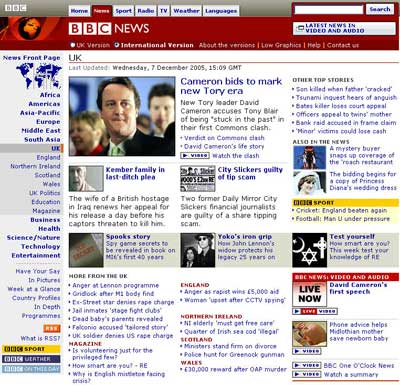
In this case, we’re dealing with English, which is read left to right. We are also dealing with U.K. cultural norms. Notice the following:
- Location of of navigation
- Use of the color red
- Use of diverse symbols
- Mix of symbols, icons and photos
- Location of Search
Now look at this design, which is the Arabic version of the BBC News, read right to left, and dealing with cultural norms within the Arabic-speaking world.
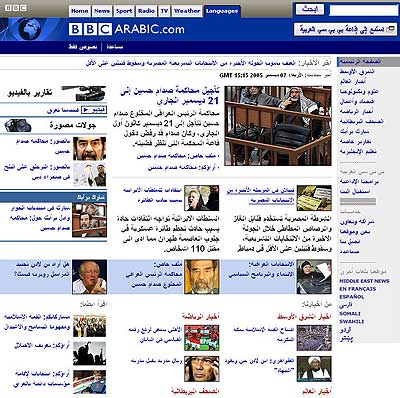
Notice the following:
- Location of of navigation (location switches to the right)
- Use of the color blue (blue is considered the “safest” global color)
- No use of symbols and icons whatsoever
- Limitation of imagery to photos
- In most cases, the photos show people, not objects
- Location of Search
Admittedly, some choices here are more obvious than others in terms of why they were made. But one thing that stands out is that the placement of search is the same for both versions. Is this the result of a specific localization decision, or based on what we believe about usability at large? This is exactly the kind of question that designers working on localization have to seek answers to, instead of relying on popular best practices and belief systems that exist for English-only Web sites.
It’s a Wide World Web After All
From this brief article on Internationalization, it becomes apparent that the art and science of creating sites for global audiences requires a lot more preparation and planning than one might think at first glance. Developers and designers not working to address these issues specifically due to time or awareness will do well to at least understand the basic process of making sites more culturally savvy, and better prepared for any future global expansion.
One thing is certain: We not only are on a dramatic learning curve for designing and developing Web sites as it is, the need to localize sites is going to become more and more a part of the day to day work. Understanding aspects of what makes a site international and local will not only help you expand your skill set and make you more marketable, but it will also expand your understanding of the world and the people within it, how they relate to and use the Web, and how you can help make their experience the best one possible.
About the author
Molly E. Holzschlag works to educate designers and developers on using Web technologies in practical ways to create highly sustainable, maintainable, accessible, interactive and beautiful Web sites for the global community. A popular and colorful individual, Molly has a particular passion for people, blogs, and the use of technology for social progress.
Photo: Pete LePage
Brought to you by

Related articles
-
Going Both Ways
Jonathan Snook saddles up to take us on a whirlwind tour of the world of bidirectional documents. “What’s left to write about internationalisation?” you may ask. Allow Jonathan, if you will, to offer you some festive words of direction.
-
JavaScript Internationalisation
Matthew Somerville takes us behind the scenes with a peek at how reindeer tackle internationalisation issues client-side. A tongue-in-cheek article with a serious message and a practical method for approaching internationalisation within JavaScript. Howzat?

